

If your to-do list keeps growing faster than your hours, you're not imagining it. AI has raised the bar for work and marketing in general: the number of things you're expected to do now, with its help, has increased.
This post covers what AI for small business marketing changes, which parts are worth taking on yourself, and when an expert who works with AI intentionally gets you further.
Table of contents
Quick answer: how should a small business use AI for marketing?
More is expected of every business now, from the same number of hours. Use AI where you're strongest, build the right tools for that work with technical support, and bring in a marketing expert who works with AI intentionally. A generic prompt gets you a generic plan, and the right questions get you one built for your business.
What's now expected of a small business
The list keeps getting longer. On the marketing side, it now includes more social posts, more blog posts, better data analysis, strategy analysis, website audits and review requests.
On the business side, it adds fixing broken operations pipelines, fixing your sales pipeline and customer interactions, and so much more. Each item is reasonable on its own. Together, they're more than one person can do well.
What the research says about AI at work
Two recent surveys show the pressure from both sides:
- 58% of AI users say they're producing work they couldn't have a year ago, and 65% fear falling behind if they don't adapt quickly, in Microsoft's 2026 Work Trend Index, a survey of 20,000 workers who use AI across 10 countries.
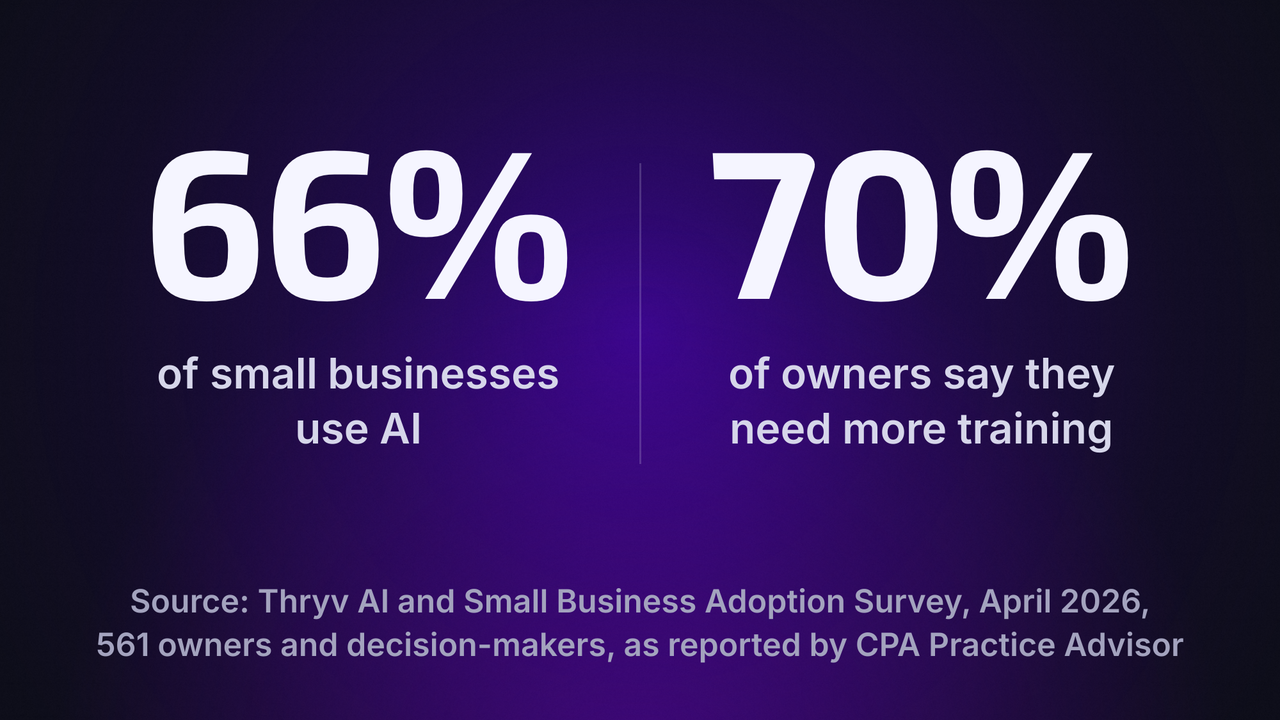
- 66% of small businesses use AI, up from 55% a year earlier, and 70% of owners say they need more training to use it productively, in Thryv's April 2026 survey of 561 owners and decision-makers, as reported by CPA Practice Advisor.
The same Microsoft report found that the most effective AI users define the outcome and the quality bar, and design how the work gets done across people and AI. Thryv sells software to local service businesses, so read its numbers with that in mind.
Focus on what you're good at
There's a lot you can do with AI. The best use of your time is the critical parts of your business that you're good at, and that's where AI earns its keep, because you can tell when its output is right.
- Keep what only you know. Your craft, your customers and the decisions that set your business apart.
- Use AI where you can judge the result. In the work you know best, a fast first draft saves time instead of adding risk.
- Hand off what takes years to do well. Marketing strategy, tracking and data analysis are full disciplines of their own.
A useful test: if you can't tell whether the AI got it right, that work belongs with someone who can.
Why "write me a marketing plan" gets you a generic plan
Don't just prompt ChatGPT with "write me a marketing plan." It will create a generic formula that could fit any business, which means it fits yours no better than a competitor's.
You might think the fix is to give it more context: your market, your margins, your customers. That helps, and it still leaves out what a marketer brings. A real marketer knows the right prompts and the right connection points, how systems interact, and how to analyze data in a more nuanced way than AI might.
- How your platforms work together. Google Ads, social media, your website, email and your CRM each do a different job, and a plan has to account for how a lead moves between them.
- The full funnel. Getting found is only the start. What happens when someone calls, fills out a form or goes quiet matters just as much.
- Customer analysis from a marketing view. What your best customers searched for, what made them choose you and what almost stopped them.
- Questions you didn't know to ask. You already have most of the answers; a marketer knows the questions that bring them out.
It's often about asking the right questions. Who is this for, which numbers point to revenue, what has been tried and what did it cost? The answers turn a generic formula into a plan built for your business.
What does it take to use AI for small business marketing well?
It comes from setting up systems and strategy, and having thought and intention behind how you use AI to produce the output.
- Systems. How the pieces connect: guidelines for how your business sounds, who each piece is for, where it goes and how you'll see what it did.
- Strategy. Knowing what you want, such as booked jobs, qualified leads or repeat customers, before you ask a tool for anything.
- Intention. Every piece has a reason to exist and a next step for the reader.
Without those three, AI for small business marketing gives you a faster way to produce work that doesn't connect to anything, and the list keeps growing.
AI output
Posts, plans and analysis
-
Systems
How the pieces connect
-
Strategy
Knowing what you want
-
Intention
Every piece has a reason to exist
Should you build your own AI tools?
Yes, the right ones. Build AI tools for the things you're good at, where your knowledge is what makes the output trustworthy.
- Start with your strongest work. You can judge the results there, so you'll catch mistakes before your customers do.
- Get technical support. Someone with technical know-how keeps the tools working and connected to the rest of your systems.
- Bring in a marketer for marketing tools. Built on your own, they miss the strategy insights and safeguards that come from years in marketing.
The goal is a tool you trust. Start small, test it on work you can check, and grow it from there.
When should you bring in a marketing expert?
For marketing or operations help, bring in an expert who understands these systems deeply and works with AI in an intentional manner.
A good marketing team has already spent a lot of time developing AI tools made for marketing. They connect them to sources like Google Analytics, Google Ads, SEO tools and research tools, and pair them with their formulas, strategies, brand voice guides and insights. That's a lot of work you don't have to repeat.
It tends to make sense when:
- You're producing more content and can't tell what it's doing for your phone and inbox.
- Leads come in and follow-up is inconsistent.
- Your website doesn't turn visits into calls or forms.
- You want senior eyes on the plan before you spend more.
A good one asks about your business before touching a tool.
Common questions about using AI in marketing
Can AI create a marketing strategy?
It can produce one, but without the right questions it will be a generic formula. Choosing what fits depends on your goals, budget, customers and market, and that judgment comes from the person directing it.
Can AI market my business for me?
It can produce and speed up pieces of the work: drafts, summaries and variations. It can't see your booked jobs, decide what your customers value or own the results, so someone still has to direct it and check what comes back.
How can AI help a small business?
Mostly by taking first passes off your plate: drafting, summarizing and sorting. It helps most in the work you already know well, where you can tell whether the output is right.
Talk with a marketing specialist
Prospect Future already has internal AI tools, combined with our marketing strategy and knowledge, that we use to support the businesses we work with. Our systems work well, so you get the benefit without building or maintaining them yourself.
We help with marketing reporting and analytics, lead generation, website creation and digital marketing consulting.
Walk away with a clear read on where your list is heaviest and where we'd start, including when the honest answer is to keep going on your own for now. Let's talk about your marketing.