The Trust Problem in Marketing
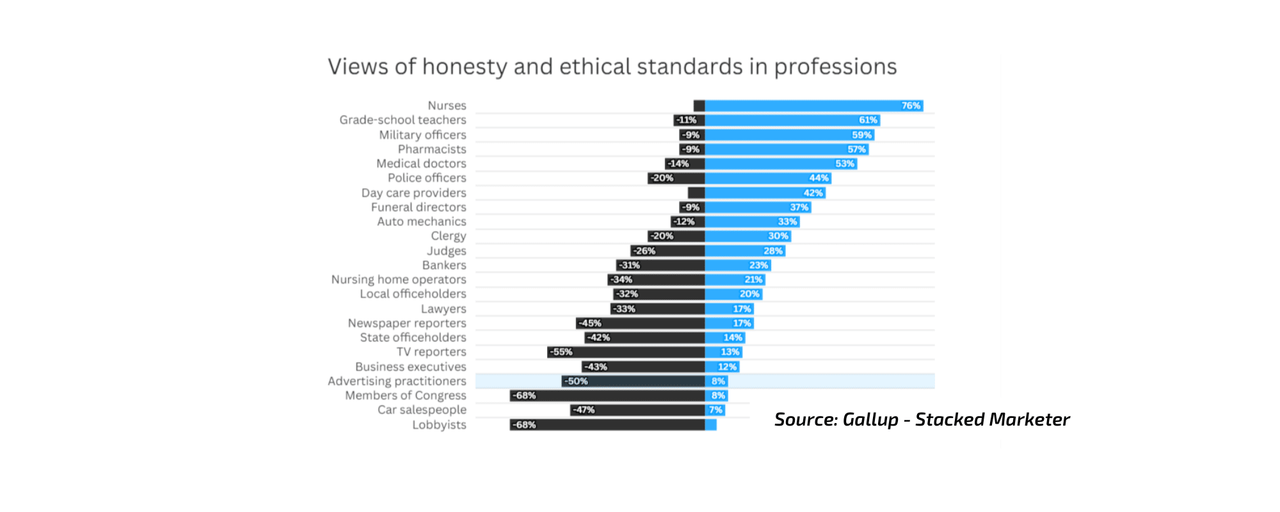
Let’s face it: marketing professionals rank among the least trusted across all industries. And honestly? I don’t blame skeptical business owners one bit.
This industry is full of snake oil salesmen, deceptive ad practices, and account managers in way over their heads. For every legitimate agency delivering real value, there are dozens making empty promises, chasing vanity metrics, and prioritizing their commission over your results.
Marketing ethics can get blurry – fast. When revenue targets loom and clients demand immediate results, it becomes tempting to cut corners. The problem is systemic: agencies often prioritize short-term wins over long-term trust and sustainability, creating a cycle that ultimately harms everyone involved.
The Trust Gap: Perception vs. Reality
The disconnect between how businesses view themselves and how consumers perceive them is staggering:
- 90% of executives believe customers trust their companies
- Yet only 30% of consumers actually report trusting the brands they do business with (PwC Trust Survey)
This perception gap isn’t accidental. It’s the direct result of marketing that promises one experience but delivers another – creating disappointed customers and damaged brand reputations.
Recent evidence of industry-wide issues continues to mount:
- The ongoing Google antitrust trial has revealed aggressive ad market manipulation tactics that have dominated the digital advertising landscape for years, directly impacting businesses’ ability to reach their audiences at fair prices (Reuters)
- The Stacked Marketer report shows that a significant percentage of users outright distrust the ads they see, with over 60% of consumers believing advertising has become more intrusive and less honest over time (Stacked Marketer)
The Structural Problems in Agency Compensation Models
The root of many marketing ethics issues lies in how agencies structure their business and compensation models:
The Billable Hour Trap
Traditional agency models center around maximizing billable hours. This creates a perverse incentive: the longer a project takes, the more the agency earns. Agencies structured this way aren’t motivated to find efficient solutions – they’re incentivized to:
- Create unnecessary complexity in campaigns
- Staff projects with excessive team members
- Develop drawn-out processes that extend timelines
The Commission Conflict
Many agencies take a percentage of ad spend as commission. This creates an obvious conflict:
- The more a client spends on advertising, the more the agency makes – regardless of results
- Recommendations to increase budgets might serve the agency’s interests more than the client’s
- Performance becomes secondary to volume of spend
The Retainer Rut
Monthly retainer models can lead agencies to:
- Push services clients don’t need to justify higher retainers
- Maintain the status quo rather than suggesting strategy shifts that might reduce scope
- Focus on retention rather than results, keeping clients paying regardless of performance
To be clear: there’s nothing inherently wrong with agencies using any of these compensation models, or even combining them. Many reputable agencies operate on billable hours, commissions, or retainers. The key is understanding how your agency makes money and being able to discern whether their recommendations come from a place of genuine strategic value or are simply designed to pad their pockets.
How Ad Platforms Contribute to Trust Erosion
The challenges don’t rest solely with agencies. The advertising platforms themselves have created an ecosystem where transparency is limited and control increasingly centralized.
Google’s Dominance and Its Impact
The Google antitrust trial has revealed troubling practices that affect every business advertising online:
- Internal documents revealed Google’s ad exchange charged fees up to 42% (significantly higher than their publicly stated rates)
- Evidence presented shows Google manipulated ad auctions to favor its own platforms
- Google’s ownership of the entire ad stack (buying tools, selling tools, and the exchange) created conflicts of interest that disadvantaged both advertisers and publishers
When platforms control the entire advertising ecosystem, even ethical agencies struggle to provide clients with fair value and transparent results.
Meta’s Measurement Challenges
Facebook and Instagram have faced similar criticism for:
- Inflating video view metrics by up to 900% in some cases
- Limiting independent verification of ad performance
- Creating “walled gardens” where data cannot be independently verified
These platform issues compound agency trust problems, making it even harder for businesses to know if they’re getting the results they’re paying for.
Common Marketing Manipulation Tactics to Watch For
Before signing with any marketing agency, be aware of these red flags that signal potential deception:
Selective Data Reporting
- Highlighting only metrics that look positive while burying those that don’t
- Cherry-picking date ranges to make performance appear better
- Creating custom metrics that lack industry standardization to mask poor performance
Case Study Manipulation
- Using outlier results as typical examples
- Presenting correlation as causation (“after our campaign, sales increased 50%” – without accounting for seasonal factors or other initiatives)
- Showcasing only successful campaigns while hiding failures
Strategic Opacity
- Using complex jargon to obscure simple concepts
- Presenting “proprietary methodologies” that can’t be externally validated
- Vague contractual language about deliverables and performance expectations
Metric Misdirection
- Emphasizing vanity metrics (likes, followers, impressions) over business outcomes
- Setting KPIs that are easy to achieve but don’t correlate with business success
- Moving the goalposts when initial promises aren’t met
The Integrity Imperative
Trust isn’t won through clever tactics; it’s built by consistently delivering value without manipulation. That applies not just to clients, but to their customers as well. Marketing integrity means playing by the rules—not because they’re convenient, but because they exist to keep the industry from being overrun by scams. At Prospect Future, integrity isn’t a points system. If it’s not consistent, it never really mattered in the first place.
This perspective might seem idealistic in an industry often defined by its worst actors. But the marketing landscape is changing:
- Privacy regulations are tightening
- Consumers are increasingly skeptical of advertising claims
- Transparency in ad performance is no longer optional – it’s expected
Finding an Agency You Can Trust
Look for these signals when evaluating potential marketing partners:
Clear Values in Action
Anyone can claim integrity on their website. Look for evidence in how they structure their contracts, handle setbacks and mistakes, and talk about previous clients.
Education Over Exclusivity
Trustworthy agencies explain their process and empower your team rather than creating dependency through “secret sauce” claims.
Consistent Track Record
Check references beyond the case studies on their website. How do they handle long-term client relationships? Do they have a pattern of short engagements?
Willingness to Say No
The most trustworthy partners will decline projects or approaches that don’t align with best practices – even when it costs them revenue.
The Long View on Marketing Trust
Building a sustainable business requires partnering with agencies that understand the fundamental truth: manipulative marketing might drive short-term results, but it creates long-term damage to both your brand and the customers you serve.
Trust isn’t a points system where ethical corners can be cut in some areas while maintaining integrity in others. Real marketing integrity means consistent alignment between what you promise and what you deliver – both as an agency and as the brands they represent.
The most trustworthy agencies don’t just say they value integrity – they structure their entire business model around it. They align their financial success with yours, provide radical transparency, and educate rather than mystify.
Taking Action: Ask the Right Questions
When evaluating marketing partners, ask direct questions that reveal their approach to trust and transparency:
- “How do you measure success for clients in my industry?”
- “Can you walk me through a time when a campaign didn’t perform as expected?”
- “Will I have direct access to my campaign data and analytics accounts?”
- “How do you ensure your recommendations align with my business goals?”
- “What happens if we don’t see the results we’re expecting?”
The challenge isn’t dismissing marketing agencies altogether, but rather identifying those rare partners who have built their entire business model around delivering authentic value.
The best agencies don’t just talk about results – they demonstrate them. They practice what they preach with their own marketing presence. They communicate openly about outcomes (both successes and failures), and they consistently educate clients throughout the journey. Most importantly, they approach every recommendation with your business goals at the center, not their profit margins.
Looking for a marketing partner that prioritizes integrity and transparency? Learn how Prospect Future approaches ethical marketing with a focus on sustainable growth.